Moon Landing's Hard Hurdles

Arvind Singh
| 29-05-2026
 · Science Team
Hi, Readers!
The Moon sits roughly a quarter of a million miles away from Earth, hanging there like it's just within reach.
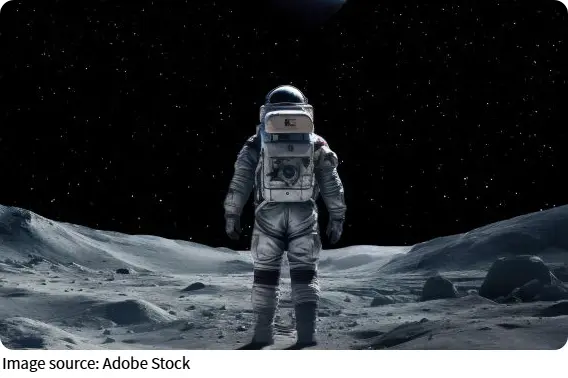
But getting a spacecraft to actually touch down softly on its surface? That's an entirely different story. Despite technological advancements, landing on the Moon remains an immensely complex and hazardous endeavor. Let's break down the real obstacles that engineers and astronauts must overcome.
No Atmosphere Means No Easy Braking
The Moon's extremely thin atmosphere prevents the use of parachutes to slow down the spacecraft during descent. Instead, the entire landing sequence must be performed using rocket engines alone, requiring precise throttle control and fuel management to achieve a gentle touchdown. There is zero margin for error here. Every kilogram of fuel must be accounted for from the moment the mission lifts off Earth, and any inefficiency could spell disaster on arrival.
The Terrain Is Unforgiving
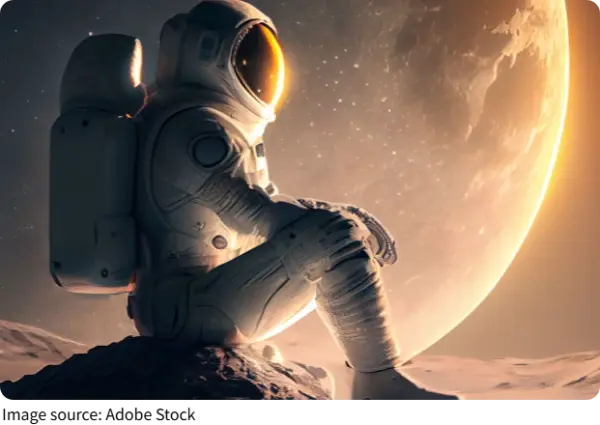
The lunar surface is covered in craters, boulders, and uneven terrain, with few flat areas suitable for landing, especially in the unexplored south polar region targeted by Artemis. The South Pole features rugged terrain with craters and boulders. The landing ellipse must be small, often less than 100 meters. This requires autonomous hazard detection and avoidance systems that function faster than human reaction times. The systems process optical and Lidar data to map the terrain underneath the vehicle during descent and adjust the trajectory to find a flat spot.
No GPS, No Easy Navigation
There is no GPS network around the Moon to assist with precision landing. The spacecraft must rely on inertial measurement units, radar/lidar, and cameras to determine its position and velocity relative to the surface during descent. On top of that, sensors can fail for a multitude of reasons such as software errors, hardware faults caused by debris or a micrometeorite impact, or malfunctions caused by components overheating, freezing, or suffering a power failure. Should a sensor malfunction not have a back-up or redundant system to compensate, there will be no way to accurately gather this essential data.
Autonomous Landing Is a Must
The 1.3-second communications delay between Earth and the Moon makes it impossible to control the spacecraft remotely from the ground. The landing must be performed autonomously by the spacecraft computer, with astronauts monitoring and ready to take over manual control if needed. That kind of split-second precision in an environment this hostile is a genuine engineering marvel every single time it works.
Deadly Dust and Extreme Temperatures
Lunar regolith is abrasive, electrostatically charged, and sharp. During landing, engine plumes accelerate this dust to high velocities. This ejecta can damage sensors, solar panels, and the vehicle structure. Meanwhile, spacecraft are subjected to immense temperature fluctuations in the vacuum of space. Spacecraft can experience temperatures as high as +125°C if exposed to direct sunlight for long periods of time and as low as -200°C if they experience night on the lunar surface. In order to survive in this environment, spacecraft must be equipped with subsystems that help them tolerate both of these extremes: thermal insulation of vital components to protect against freezing temperatures, and heat pipes and thermal radiators to prevent overheating during extremely hot periods.
Tricky Lighting Conditions
The Apollo landings took place in the well-lit equatorial regions, but Artemis aims to explore the permanently shadowed south pole crater where ice deposits are thought to exist. The low sun angles will cast long shadows, distorting visual navigation cues during the final approach. Timing is everything. The tidal locking of the Moon's orbit means the length of a lunar day is the same as the length of its orbit around Earth: 29.5 Earth days, with "daytime" and "nighttime" on the Moon each lasting roughly two weeks. Landing too late in the lunar day will leave scientific instruments with too little time to collect their data before they are forced to permanently shut down when the sun sets on the landing site.
New Spacecraft, New Unknowns
The Artemis landers will use different designs and propulsion systems than Apollo. New vehicles like SpaceX's Starship are still in development and will have limited testing in lunar conditions before crew flights. Perfecting new spacecraft is a challenge. Commercial companies face the same technical hurdles as government agencies but often with tighter budgets, smaller teams and less heritage hardware. Unlike government missions, which can draw on decades of institutional experience and infrastructure, many commercial lunar efforts are navigating these challenges for the first time.
Every Moon mission that launches, whether it succeeds brilliantly or stumbles partway, teaches engineers something new. These missions help engineers learn to navigate the complexities of space, operate in hostile lunar environments, and steadily advance toward a sustainable human presence on the Moon. The challenges are real and serious, but so is humanity's drive to keep pushing further. Next time you glance up at the Moon at night, give a quiet nod to the teams working relentlessly to make this remarkable journey look easy.